
Walk into any new residential project in Bangalore today and there’s a good chance the word “premium” appears somewhere before you’ve even spoken to the sales team. It’s on the hoarding outside, the brochure inside, and the website you visited last night. It’s used so often, and across such a wide range of projects, that it has quietly stopped meaning much.
Which puts buyers in a difficult position. If every developer is calling their project premium, how do you evaluate whether a flat actually is? And more importantly, what are you paying for when you pay the premium price?
This guide attempts to answer that honestly.
Defining Premium: Where It Sits in Bangalore’s Market
Before you can evaluate a flat against a standard, you need to know what the standard is. Bangalore’s residential market broadly sorts into four tiers: affordable (below ₹50 lakhs), mid-segment (₹50 lakhs to ₹1 crore), premium (₹1 crore to ₹3 crore), and luxury (₹3 crore and above).
Premium, in other words, is not the top of the market, it’s the well-considered middle of it. The buyer in this segment is typically a senior professional, a family upgrading from an older flat, or an investor looking for meaningful appreciation without moving into a category where liquidity becomes thin. They’re spending real money and they want real quality, but they’re not in the market for concierge services or private lift lobbies.
A premium flat should give you better-than-average finishes, a genuine amenities ecosystem, smart spatial planning, and a location with credible long-term value. It should not require a marketing team to convince you it’s good, the quality should be visible and felt.
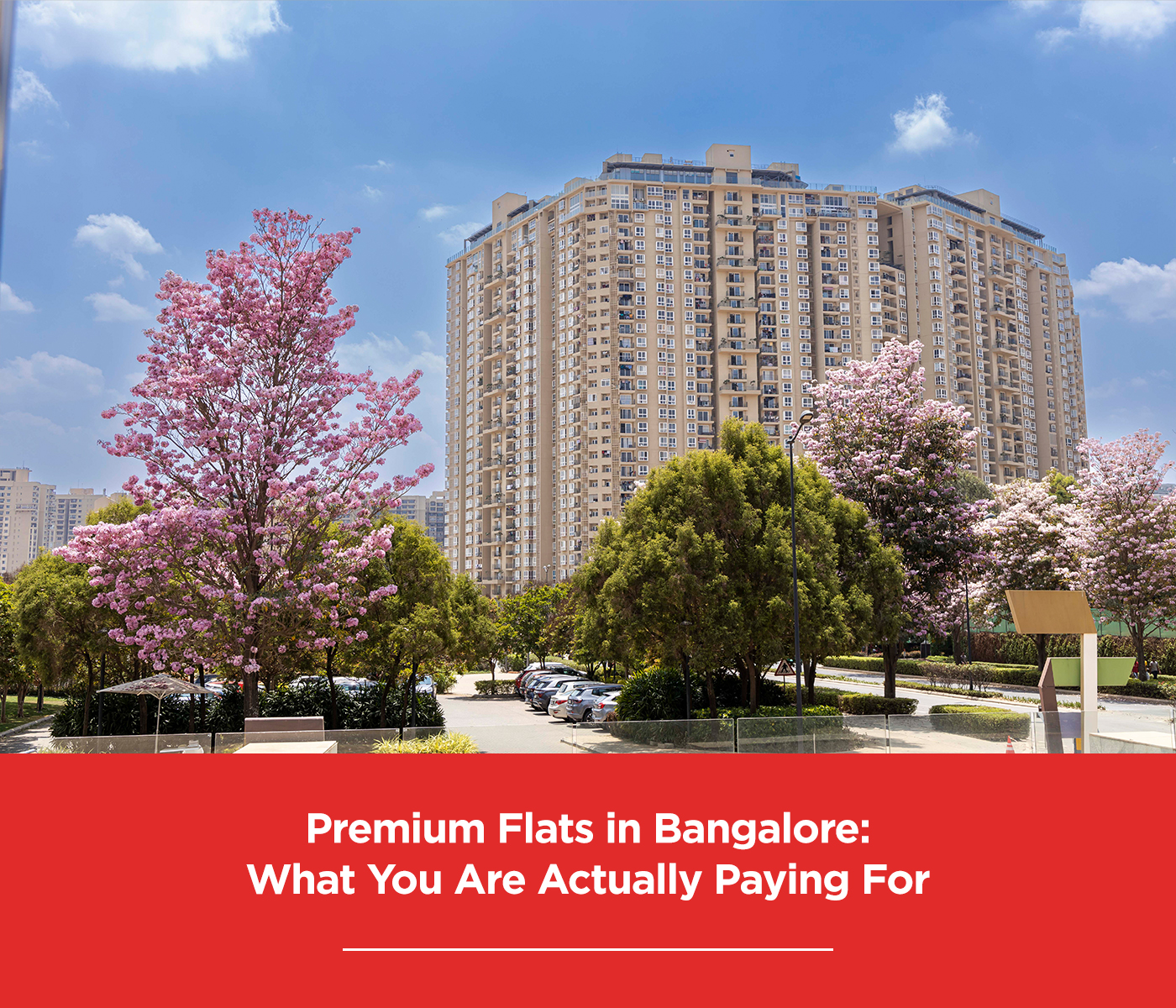
Interior Finishes and Fittings: What Separates the Real from the Dressed-Up
This is where most buyers can make the clearest assessments and where developers most often blur the line between genuine premium quality and mid-segment construction with an upgraded sales centre.
Flooring is usually the first tell. Vitrified tiles (double-charged or full-body) in the 800×800mm or 1000×1000mm format are the baseline for premium. Anything smaller or lower in grade is mid-segment regardless of what the brochure says. In genuinely premium homes, you’ll also see Italian marble or engineered wood in the master bedroom, materials that have tactile quality you notice without being told to.
Kitchen specifications matter more than buyers initially realise, because they affect daily life more than any other space. Look for: granite or engineered stone countertops (not tiles), a concealed plumbing arrangement, provisions for chimney and hob, and stainless steel or quartz sinks with quality faucets. Modular kitchens are increasingly standard in premium projects, though the quality of the modular units (carcass material, shutter finish, hardware) varies significantly between a genuine premium project and one that uses the word loosely.
Bathroom fittings follow a similar logic. Branded sanitary ware (Kohler, Duravit, Jaquar, or equivalent) and concealed CP fittings signal premium-grade specification. Exposed fittings, unbranded fixtures, or low-grade tiles in wet areas are mid-segment regardless of the rest of the home.
Doors and windows are often overlooked but are among the most durable indicators of build quality. Premium homes use solid-core flush doors (not hollow-core) for internal rooms, UPVC or aluminium double-glazed windows for thermal and acoustic performance, and a main door with a specification that reflects the entrance’s importance. Bay windows, where the window extends beyond the wall plane to increase light and create a sense of space, are a design feature that signals thoughtful architecture rather than value engineering.
Electrical and plumbing provisions are the hardest to evaluate on a showroom visit but among the most consequential. Ask specifically: Is there a dedicated circuit for the air conditioner in each bedroom? Is there a VRF/VRV provision, or is it split-unit only? Are water points provided for washing machines in a logical location? Premium projects build these in; mid-segment ones leave them as future problems.
Luxury interiors typically run 40–70% higher than premium for the same carpet area, mostly driven by material sourcing, imported versus domestic, and the labour skill required for detailing. This is the useful dividing line: premium uses quality domestic materials, well-specified and well-finished. Luxury moves into imported materials, custom millwork, and architectural detailing. Both can be excellent.
Community Amenities: The Difference Between a Checklist and an Ecosystem
Every premium project in Bangalore will claim a clubhouse, a swimming pool, a gym, a children’s play area, and landscaped gardens. These have become table stakes, not differentiators. The real question is not whether the amenities exist, it’s whether they work, and for whom.
The ratio test. Divide the total clubhouse area by the number of units. Below 10 sq ft per unit and you have a facility that will feel overcrowded at peak hours within a year of possession. Genuinely premium projects aim for 15 sq ft per unit or more. At Nikoo Homes 8, the 45,000 sq ft clubhouse serves approximately 500 units in Phase 1, a ratio that ensures the amenities don’t become theoretical.
Open space as a design choice. In Bangalore’s dense residential market, open space is frequently whatever’s left after the towers are placed. In a genuine premium project, it’s the other way around, the open space is designed first, and the towers are arranged around it. Look for a project’s open-space-to-total-area ratio. 60% and above signals a real commitment. Projects that achieve 70%+ are meaningfully differentiated; Bhartiya Garden Enclave’s 74% open space is at the upper end of what’s achievable at scale.
Amenities that serve different residents, not just one profile. A project with a gym, a yoga deck, a co-working lounge, a sensory garden, and a children’s play area is serving a genuinely diverse resident community. A project with a gym and a party hall is serving a narrower imagination of who lives there. The best premium projects plan for seniors who want to walk in the morning, children who need safe outdoor space, and professionals who need a quiet corner during the day, not just the resident who wants to host a party on Saturday.
Maintenance quality over time. The amenities in a showroom visit will always look their best. Ask the developer what the maintenance charge structure is, how the amenities are managed post-possession, and whether past projects have active, well-maintained common areas. This is where a developer’s track record becomes the most meaningful variable of all.
Location Factors That Make a Premium Flat a Smart Long-Term Investment
Paying a premium price for a flat in the wrong location is one of the more expensive mistakes a homebuyer can make. Location is the one factor in real estate that cannot be changed after purchase, and for a premium flat, the location needs to earn its premium over a 7-10 year horizon.
Employment proximity is the most durable driver of residential value. Bangalore’s real estate history is essentially a record of neighbourhoods that appreciated because jobs moved nearby. Whitefield’s run in the 2010s was driven by IT campus expansion. Sarjapur Road’s growth followed Electronic City and the ORR corridor. North Bangalore’s current momentum is anchored by Manyata Tech Park, Embassy Golf Links, and a growing number of SEZs and tech campuses in the Devanahalli corridor. A premium flat that puts the buyer’s commute inside 20 minutes is one that will generate both rental demand and resale interest because the population of potential tenants and buyers is large and stable.
Infrastructure pipeline, not just current connectivity. The value premium for a location is often priced in before the infrastructure actually arrives. The Namma Metro Phase 2B Blue Line extension, the Peripheral Ring Road, and the Bengaluru Suburban Rail Project are all concentrating their impact on North Bangalore, meaning buyers who enter this corridor before these projects deliver are buying ahead of the value curve rather than after it.
Social infrastructure density matters for families. Schools, hospitals, and retail within accessible distance are the daily-life metrics that determine resident satisfaction over the long term. In the Thanisandra corridor, Aster CMI and Manipal hospitals, Elements Mall, Chaman Bhartiya School, the Bhartiya Mall of Bengaluru, REVA University, and Kristu Jayanti College are all within the immediate catchment. These aren’t necessarily all amenities the developer built, they’re the social fabric of the neighbourhood, and they make the location self-sufficient in a way that younger corridors aren’t yet.
The township adjacency advantage. One location factor that’s genuinely under-appreciated in Bangalore’s premium market is the benefit of being close to an established integrated township without paying the highest township premium. A premium flat that sits adjacent to a live, functioning township inherits the retail, hospitality, and community ecosystem that the township has already built, while typically entering at a lower per sq ft price than the township’s own inventory.
What Sustainable Features Should a Premium Flat Actually Have?
This section matters more than it used to. Bangalore’s water situation is not improving, the city’s biggest water source, the Cauvery, is under dire stress for lack of adequate supply to meet demand. For buyers in the premium segment, a project’s approach to sustainability is no longer a value statement. It’s a practical question about the long-term cost of living there.
Here’s what to look for, and what each feature actually delivers:
Rainwater harvesting. Mandatory for buildings above a certain threshold in Bengaluru, but the quality of implementation varies. A properly designed system with rooftop collection, underground storage, and filtration for reuse in landscaping and flushing can reduce a building’s dependence on municipal water by 30–40%. Ask whether the system is passive collection or actively managed.
Sewage Treatment Plant (STP). Mandatory for residential complexes above 20 units under BWSSB norms. An STP treats wastewater to a quality suitable for flushing and landscaping, reducing the building’s freshwater demand and the burden on municipal infrastructure. The quality of the STP and whether treated water is actually reused (rather than discharged) is the real differentiator.
Solar power for common areas. Rooftop solar generating electricity for elevators, lighting, and common area power reduces both the maintenance charge burden and the project’s carbon footprint. Certified green buildings consume 30–50% less energy compared to conventional buildings, savings that flow through directly to lower maintenance charges over a building’s life.
Green building certification. IGBC (Indian Green Building Council), LEED, and GRIHA are the three certifications worth asking about. IGBC is the most widely used in India and offers ratings from Certified through Platinum. A Gold or Platinum IGBC rating, or a 4-5 star GRIHA rating, means the project has been independently assessed and audited, not self-declared. Over 65% of buyers under 40 said they are willing to pay a premium for homes with green certifications or eco-friendly features, citing lower energy bills, better health outcomes, and higher resale value as their top reasons.
Low-VOC paints and indoor air quality. Less visible than solar panels but arguably more relevant to daily health. Low-VOC (volatile organic compound) paints and finishes reduce the chemical off-gassing that affects indoor air quality for years after possession. In a city where outdoor air quality is increasingly compromised, a home that actively manages indoor air quality is a meaningful differentiator.
The honest way to evaluate sustainability claims: ask whether there’s certification from an independent body, whether the features are built in (not add-ons), and whether they’ve been delivered in the developer’s past projects. Sustainability on a brochure is easy. Sustainability in an occupied building is the real test.
Nikoo Homes: Premium Flats in North Bangalore Built for Modern Life
Premium flats in Bangalore that actually earn the label tend to share a few characteristics: quality that doesn’t require explanation, amenities that are used rather than photographed, a location that makes daily life easier rather than aspirational, and a developer who has delivered the same standard before.
Nikoo Homes 8 at Bhartiya Garden Enclave on Thanisandra Main Road is designed around these principles. The project brings together studios through 4 BHK homes, loft apartments, and Nikoo Courtyard Villas, each configuration designed around how people at different life stages actually live. Bay windows that keep homes bright through the day. Decks that make evenings usable. Layouts where the kitchen, dining, and living blend into one large family space for households that run that way.
The 45,000 sq ft clubhouse across Phase 1’s approximately 500 units means the pool, co-working lounge, sports courts, sensory garden, meditation garden, and celebration lawns are genuinely accessible at any given time and not rationed by density. The 74% open space across the 11-acre site means the development breathes in a way that most North Bangalore projects don’t.
And the adjacency to Bhartiya City, seven minutes away, with The Leela hotel, Bhartiya Mall of Bengaluru, and Chaman Bhartiya School already functioning, means the location inherits a neighbourhood that is already alive. The social infrastructure, the retail, the sense of community: these exist today, not in the developer’s future-state renders.
For buyers looking at premium apartments in Bangalore in the ₹1–3 crore range, the evaluation framework matters more than the marketing. When you apply the criteria that actually distinguish a premium flat from a well-dressed mid-segment one like finishes, amenity ratios, location fundamentals, sustainability, and developer track record, the picture becomes considerably clearer.
The mock flats at Bhartiya Garden Enclave are open throughout the week. Walking through one, and then through the Bhartiya City township seven minutes away, tends to answer most of the questions that brochures leave open.
Explore luxury flats in Bangalore and luxury projects in North Bangalore to understand the full range of what the Nikoo Homes portfolio offers across price points.
Frequently Asked Questions
What is the difference between premium and luxury flats in Bangalore?
The distinction is primarily about price point, specification level, and density. Premium flats in Bangalore are broadly priced between ₹1 crore and ₹3 crore, use quality domestic materials, and offer well-proportioned amenities at a community scale. Luxury begins at ₹3 crore and typically involves imported finishes, private lift lobbies, fewer units per floor, and concierge-level services. A genuine premium flat should feel well-built and thoughtfully designed without requiring imported marble and dedicated lifestyle managers to justify its price.
What price range qualifies as a premium flat in Bangalore?
The premium segment in Bangalore’s current market broadly runs from ₹1 crore to ₹3 crore across configurations. Within this range, 2 BHK flats in established North Bangalore projects typically fall between ₹1.2 crore and ₹2 crore depending on size, floor, and developer. Studios and 1 BHKs in premium projects can start below ₹1 crore while still meeting premium specification standards. Nikoo Homes 8 offers studios from ₹67 lakhs and 1 BHK homes from ₹91 lakhs in a township environment on Thanisandra Main Road.
Do premium flats in Bangalore come with modular kitchens and wardrobes?
Increasingly yes, though the quality varies significantly between projects. A genuine premium project will provide a modular kitchen with a quality carcass (marine ply or equivalent), shutters in acrylic or membrane finish, and hardware from branded manufacturers like Hettich or Hafele. Modular wardrobes in bedrooms are also standard in the better premium projects. Always verify the brand and specification of modular fittings in the flat agreement. Today, “modular kitchen” is not a specification, it’s a category.
Which locations in Bangalore offer the best premium flat options?
North Bangalore, specifically the Thanisandra, Hebbal, Hennur, and Yelahanka belt, currently offers the strongest combination of premium flat supply, price-to-space ratios, and long-term appreciation potential. Whitefield and Sarjapur Road remain active premium markets but have already priced in much of their maturity. South Bangalore (Kanakapura Road, Bannerghatta Road) offers lifestyle and stability but less appreciation headroom. For buyers who want premium specifications at the most compelling price relative to location fundamentals, the North Bangalore corridor is the most competitive market today.
Are premium flats near tech parks in North Bangalore a good long-term investment?
Yes, with the right project. The combination of Manyata Tech Park’s employment anchor, incoming metro connectivity, the PRR, and a consistent supply of IT professionals who prefer to live close to work creates structural rental demand in the Thanisandra–Hebbal corridor. Rental yields in premium projects in this belt hold at 3–4%, and capital appreciation has been tracking at approximately 8–10% annually in well-located developments. The 5–10 year view here is supported by fundamentals rather than sentiment.
What sustainable features should premium flats in Bangalore have?
At minimum: a properly designed rainwater harvesting system with functional storage and reuse, a Sewage Treatment Plant with treated water reused for landscaping and flushing, solar power for common areas, and low-VOC interior finishes. Better projects will also carry IGBC or GRIHA certification, which means an independent body has audited these claims rather than the developer self-declaring. Certified green buildings in Bangalore typically deliver 30–50% lower energy consumption and up to 50% water savings compared to conventional construction; these savings reduce maintenance charges and improve the long-term cost of ownership meaningfully.